
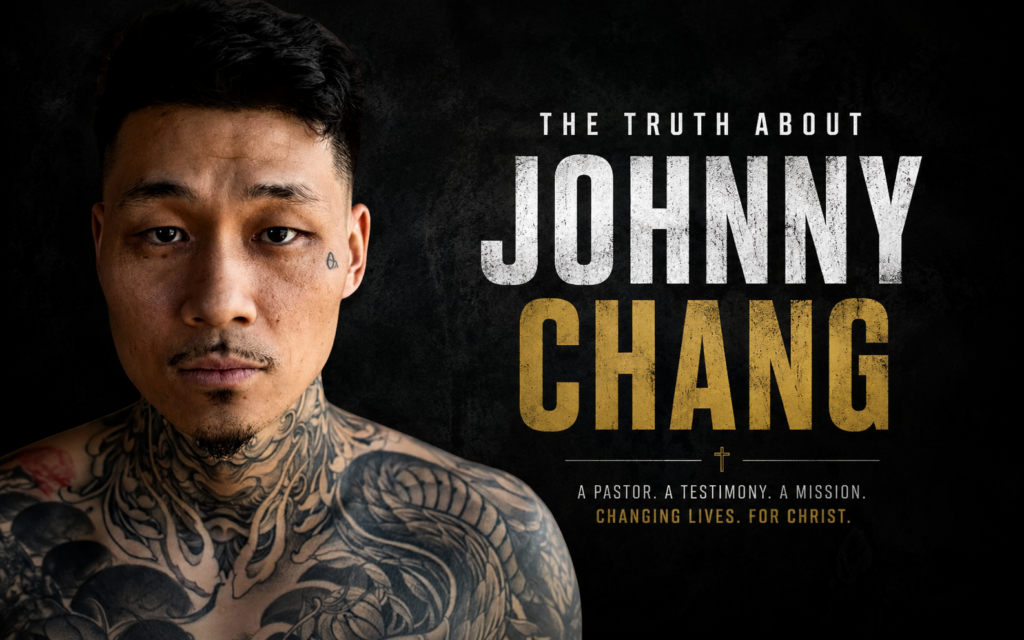
Johnny Chang is a pastor and minister based out of the Los Angeles area, and he has become the subject of a lot of controversy.
So let’s get straight to the point.
Yes, Johnny Chang has publicly described himself as a former gang member. Yes, his testimony includes violence, prison, drugs, anger, abuse, and a life that most church people would rather discuss from a very safe distance. He has spoken openly about joining the Wah Ching gang at a young age, being locked up as a juvenile, later being tried as an adult, serving years in prison, and coming out with a heart still full of rage, pride, and survival instincts.
That is not the controversy.
At least, it should not be.
The controversy is not that Johnny says he was a sinner. Christianity has never been built on the idea that God only uses clean people with polished shoes and soft hands. The Bible is full of people who would probably fail a modern church background check. Moses killed a man. David committed adultery and arranged a death. Paul persecuted Christians before becoming one of the most important voices in the New Testament.
So if the complaint is simply, “Johnny Chang had a dark past,” then I have to ask what Bible people are reading.
Johnny does not hide from that past. He does not present it like some trophy on a shelf. He does not seem proud of it. He owns it as sin. He talks about it as brokenness. He acknowledges that his life was shaped by abuse, anger, violence, drugs, prison, and the kind of pain that does not just go away because someone tells you to smile more.
That is part of why people listen to him.
Because a lot of people do not need another preacher who sounds like he was assembled in a church lobby. They need someone who can speak to the person who thinks they are too dirty, too far gone, too damaged, too angry, too addicted, too ashamed, or too ruined for God to use.
Johnny Chang speaks directly to those people.
And I am one of them.
What Can Actually Be Verified
Now, if I am going to write about Johnny honestly, I have to be fair. Not every single detail floating around online can be fully verified through public records. That matters.
The broad outline of Johnny’s testimony is repeated across multiple public sources. He has been described as a former gang member, former inmate, drug dealer, and later a minister or pastor. Public articles and church event pages repeat the basic story: childhood abuse, gang life, juvenile incarceration, adult charges, a long prison sentence, release, a return to street life, and then a dramatic shift toward Christianity.
Some sources say he joined a gang around age twelve. Some describe four years in juvenile detention. Some say he was later tried as an adult and sentenced to ten years for assault with a deadly weapon connected to an attempted robbery. Some describe him serving eight and a half years of that sentence. His story has also been tied to drugs, violence, prison survival, and a robbery attempt that became one of the turning points in his life.
That is the broad public story.
But here is where I want to be careful: I could not verify every dramatic detail through public court records. That does not mean those details are false. It also does not mean they should be repeated as proven fact without caution.
This is especially true with juvenile records. In California, juvenile records are often confidential and can also be sealed. So the fact that a normal person cannot find every record online does not automatically disprove Johnny’s story. That would be a lazy conclusion. At the same time, the lack of easy public records also means I should not pretend every claim is nailed to the wall with paperwork.
For example, I have seen people repeat the claim that Johnny left a man wheelchair-bound for life. I am not saying that is false. I am saying I could not confirm that specific claim from the public sources I found. So the responsible way to say it is this: Johnny’s testimony includes serious violence and assault, and public summaries of his life support that broad claim. But some of the most specific details should be treated as part of his testimony unless stronger documentation is available.
That is not weakness. That is honesty.
And honestly is exactly what this subject needs, because both sides can get sloppy.
Some supporters want to defend everything instantly because Johnny helped them understand God. I get that. I really do. But liking someone’s ministry does not mean we should turn our brains off.
Some critics want to throw out his entire testimony because they cannot find every document on Google. I think that is just as sloppy. The absence of easy internet paperwork is not proof of fraud, especially when juvenile records and old prison records are not always sitting there waiting for a Reddit detective with a Mountain Dew and a theory board.
The truth is somewhere more mature than both extremes.
The Criminal Past Is Not the Main Point
A lot of the online fighting focuses on whether Johnny was exactly what he says he was.
Was he really a gang member?
Was he really violent?
Was he really in prison?
Was he really a drug dealer?
Was he really as bad as the testimony sounds?
Those questions matter to a degree, especially if someone is building a public ministry around a personal story. I understand why people ask them.
But at the same time, I think people are missing the larger point.
The most important question is not only, “Who was Johnny Chang?”
The more important question is, “Who is Johnny Chang now, and what fruit is coming from his life?”
Because if Christianity teaches anything, it teaches that people can actually change. Not pretend to change. Not rebrand. Not slap a Bible verse over the same old heart and call it ministry. Actually change.
Johnny’s old life matters because it shows the depth of what God can pull a person out of. But his current life matters more because that is where we see what happened after the testimony.
And that is where the story gets interesting.
From Prisoner To Preacher Was Not Overnight
One thing I think people get wrong about Johnny Chang is the assumption that he walked out of prison, grabbed a Bible, opened Instagram, and declared himself a preacher.
That is not the timeline he presents.
By his own account, a major part of his formation happened under Pastor Kim. Johnny has spoken about meeting Pastor Kim through his mother, being drawn into church life, struggling between his old life and his new one, and eventually going deeper into discipleship. His own podcast material describes an extended period before he became widely known: church life, dorm life, early prayers, menial work, correction, pride being challenged, learning to be teachable, and accepting the idea of ministry.
That matters.
Because there is a massive difference between a man who goes viral and appoints himself, and a man who spends years being shaped, corrected, humbled, and trained before the platform ever shows up.
Johnny has publicly said Pastor Kim was the person who truly opened his heart to the gospel. Whether someone agrees with every part of Johnny’s theology or not, it is hard to understand his ministry without understanding that relationship. Pastor Kim seems to have been one of the main human instruments God used in Johnny’s life.
And that is not always fun work.
Real discipleship is not just someone telling you that you are amazing while Christian music plays softly in the background. Real discipleship is someone seeing the parts of your heart you are still trying to hide. It is correction. It is humility. It is being told no. It is learning to serve when nobody is clapping. It is scrubbing toilets when your pride still thinks you should be handed a microphone.
That part of Johnny’s story is important because it shows that his public ministry did not come out of nowhere. There was a process. There were years of formation. There was church authority. There was correction. There was a pastor speaking into his life before millions of people ever knew his name.
His Bible Study Claims Need To Be Stated Carefully
This is one area where I had to correct my own understanding.
I had heard the claim that Johnny read the Bible fifty-six times. I could not verify that number.
The strongest public claim I found is that Johnny has read the Bible front to back more than twenty-five times. One public source connected to his ministry says “over 25 times,” and another social media source referenced twenty-four times. So unless someone has a direct clip or source where Johnny says fifty-six, I would not publish that number as fact.
But even with that correction, reading the Bible more than twenty-five times is not nothing. That is not casual Sunday scrolling. That is not “I read Jeremiah once and now I am a prophet.” That is years of repetition, wrestling, rereading, and letting the text work on you.
Johnny also regularly talks about studying Scripture through original-language tools. He has referenced reading with the King James Version alongside Koine Greek and Hebrew-Aramaic. His teaching often leans into word studies, especially when he believes English church language has flattened a biblical idea into something too shallow.
For example, he has taught on words like repentance, confession, holiness, and heresy by going back to Greek terms and trying to explain them in a way normal people can understand. That is part of what makes him effective. He does not always sound like an academic lecture. He often takes church words that people have heard a thousand times and breaks them open in a way that hits the heart instead of just floating around the skull.
Now, I also want to be fair here. I am not going to claim he is a formal biblical-language scholar unless there is a credential proving that. I am not going to say he is fluent in every original biblical language or that he can recite Scripture perfectly in Hebrew, Aramaic, and Greek unless that is directly proven.
What I can say is this: Johnny clearly studies the Bible intensely, he publicly claims to have read it more than two dozen times, and he uses original-language study as part of how he teaches. Whether someone agrees with every conclusion he draws is a separate issue. But it is not fair to pretend he is just winging it with a microphone and a prison story.
Why People Like Me Listen
This is where I stop writing like a researcher for a second and write like a person.
Johnny Chang was one of the people who helped me believe that someone like me could still be worthy of salvation.
I know some people will read that and immediately want to correct the wording. “None of us are worthy.” Yes, I know. That is the point. But there is knowing that as doctrine, and then there is actually believing God’s grace can reach you personally.
Those are not always the same thing.
A lot of us grew up with hard lives. A lot of us have done things we are not proud of. A lot of us have anger, shame, regret, and old survival habits that do not fit neatly inside polite church culture. Some people hear “Jesus loves you” and feel comfort. Other people hear it and think, “Maybe other people, but not me. You do not know what I have done. You do not know what lives in my head. You do not know what I have been through.”
Johnny reaches that person.
That is not because he waters everything down. It is because he speaks from a place that feels real. When someone with a past like his says God can change a life, it lands differently. It does not sound like a slogan printed on a church mug. It sounds like a man pointing to the wreckage and saying, “God pulled me out of that.”
And for people in prison, that matters even more.
Johnny has spent time in prison ministry, and that may be one of the clearest examples of why his past has become useful instead of just tragic. A normal pastor can preach in prison. Of course he can. God can use anyone. But there are some men behind those walls who are not going to listen to a polished speaker who has never been close to their world.
Johnny can walk in and say, “I know this place. I know this mindset. I know what rage feels like. I know what it means to be locked away. I know what it means to think you are beyond repair.”
That opens doors.
Not every pastor has that key.
The Prison Ministry Is Real
Johnny’s prison ministry is not just a branding line. It is part of his actual ministry work.
Core of the Heart, his ministry platform, includes prison ministry, Bible classes, mentorship, live events, podcasts, devotionals, and documentary content. His documentary Faith on Death Row brought attention to his work inside prisons, and outside organizations have also documented him going into correctional facilities to preach and answer questions from inmates.
That does not mean every part of his ministry is above criticism. No public ministry should be above criticism. But it does mean the work is not imaginary.
And again, this is where people need to be careful. If someone wants to critique his doctrine, fine. If someone wants to ask questions about affiliation, training, records, or ordination, fine. Those are fair lanes.
But if someone looks at a former inmate going back into prisons to preach Christ to men society has mostly thrown away, and their first instinct is contempt, I think they need to ask what spirit that is coming from.
Because Jesus was very comfortable going after the people religious society had already written off.
The Good News Mission Question
Now we have to talk about the part that a lot of defenders do not want to touch.
Some of the serious criticism around Johnny Chang is not just about his criminal testimony. It is about doctrine and church affiliation.
Public evidence connects Pastor Kim’s church world to Good News Mission-related organizations. Good News LA Church identifies with Good News Mission, CLF USA, IYF USA, and Mind Education. Critics of Good News Mission have raised concerns about doctrine, authority, perfectionism, and whether the movement teaches ideas about sin and salvation that other Christians would consider unhealthy or unbiblical.
That does not automatically mean every accusation is true. It also does not automatically mean Johnny is teaching false doctrine. But it does mean the concern is not imaginary.
Some Christian critics argue that Good News Mission has serious theological problems. Some former members describe it in very negative terms. Other sources note that the group denies cult accusations and presents itself as a Christian mission movement.
So the fairest way to say it is this: Johnny Chang’s controversy is not only about whether people believe his testimony. It is also about whether people trust the theology and church network connected to his formation.
That is a real issue.
And honestly, I think it should be discussed openly instead of hidden under emotional reactions.
If Johnny is right, his teaching should be able to withstand scrutiny. If critics are right, their criticism should be specific and biblical, not just internet screaming with dramatic music. “I do not like his vibe” is not discernment. “He helped me” is also not a full theological defense.
Both sides need to do better.
What I Think Critics Get Wrong
The biggest thing I think critics get wrong is acting like a dark past disqualifies a transformed person forever.
That is not Christianity.
If anything, Christianity is the story of God taking people who should not make sense and using them anyway. God does not seem nearly as afraid of messy people as religious people are. Jesus spent time with tax collectors, prostitutes, sinners, outcasts, and the kind of people respectable society had already filed under “trash.”
So when people act shocked that God might use a former gang member, I wonder if they have actually paid attention to Jesus.
That does not mean Johnny gets a free pass forever. It does not mean nobody can question him. It does not mean his doctrine should not be tested. It does not mean his testimony should never be examined. Public teachers should be tested more, not less.
But there is a difference between testing a teacher and resenting redemption.
Some people seem less interested in truth and more offended that God might use someone they would not have picked.
And that is a dangerous place to stand.
What Supporters Should Be Careful About
At the same time, supporters need to be careful too.
If Johnny helped you, I understand why you want to defend him. I am in that camp. His teaching helped me see grace differently. His testimony helped me believe God could still use broken people. His way of explaining certain biblical ideas made the gospel feel less like a locked church office and more like something I could actually walk toward.
But support should not turn into blindness.
Do not exaggerate claims. Do not repeat numbers you cannot verify. Do not say every criminal detail is proven if you do not have the records. Do not pretend the Good News Mission concerns do not exist. Do not treat every critic as an agent of Satan just because they ask a hard question.
Truth does not need bodyguards with bad arguments.
If Johnny’s ministry is from God, then honesty will not destroy it.
The Real Fruit
Here is what I keep coming back to.
Johnny Chang is reaching people many churches are not reaching.
He is reaching prisoners. He is reaching addicts. He is reaching men with anger issues. He is reaching people with shame. He is reaching people who were hurt by religion. He is reaching people who think they are too far gone. He is reaching people who hear normal church language and feel nothing because it sounds like it was written for someone else.
That does not automatically settle every doctrinal question. But it does matter.
Jesus talked about fruit. Not image. Not polish. Fruit.
And when people are being pushed toward Scripture, toward prayer, toward repentance, toward Jesus, toward confession, toward change, toward hope, and away from the idea that they are permanently disqualified, I have a hard time pretending that means nothing.
For me personally, Johnny was one of the voices that helped me believe grace was not just a concept for cleaner people.
I never committed crimes at the severity Johnny describes. But I have done enough wrong in my life to understand shame. I have done enough wrong to feel unworthy of God. I have carried enough damage to think maybe salvation was real, but maybe not for me. Maybe I had one direction to go after death and that was just it.
Johnny’s teaching challenged that.
Not because he made sin small.
Because he made grace look big.
So What Is The Truth About Johnny Chang?
The truth is probably not as simple as either side wants it to be.
Johnny Chang is a real pastor with a real platform, real prison ministry work, real influence, and a real testimony of coming out of darkness. His broad story of gang life, prison, drugs, violence, trauma, and conversion is publicly repeated across multiple sources and consistent with what he says about himself.
At the same time, not every specific detail can be easily verified through public records. Some claims should be stated carefully. His exact ordination trail is not fully documented in the public sources I found. His Bible-reading claim should be stated as more than twenty-five times, not fifty-six, unless a better source is found. His original-language study should be described as serious study and regular use in teaching, not exaggerated into formal scholarly credentials unless those credentials are proven.
And the doctrinal concerns around Good News Mission and related church networks should not be ignored. They should be examined carefully, biblically, and honestly.
But after all of that, here is where I land.
If someone wants to criticize Johnny Chang, criticize him with truth. Criticize doctrine with Scripture. Criticize unverifiable claims with careful evidence. Criticize public teaching with biblical clarity.
But do not criticize the idea that God can use a man with a violent past.
Because if that bothers you, your issue may not be with Johnny Chang.
Your issue may be with grace.
The Bible is not the story of God finding impressive people and making them slightly more impressive. It is the story of God raising the dead, cleansing the unclean, forgiving the guilty, and sending broken people back into broken places with a message of life.
Johnny Chang’s past is not clean.
That is the point.
If God can take a man like that and use him to reach prisoners, addicts, outcasts, angry men, ashamed people, and lost sheep who would never walk into a normal church, then maybe we should be slower to sneer and quicker to ask what God is doing.
Because Jesus did not come for people who think they need a little improvement.
He came for the lost.
And whether people like Johnny Chang or not, he is reaching a lot of them.